Why habits help
Much of what we think each day follows paths we already know. That is not a flaw. Experience lets us find our way quickly, act reliably and save our attention for what is new.
Think of a task you have done many times at work, such as preparing a regular report or answering a familiar kind of request. You already know the steps: what matters, what to check and what usually goes wrong.
This is habitual thinking: thinking that repeats what has worked before. It is useful and keeps its place.
When a familiar solution narrows the view
Habits can limit us in two ways. A solution that has always worked can hide other options, because we stop looking once something works. And a solution that fitted well in the past may no longer fit when the situation has changed.
Behind both lie mental maps: simplified pictures of how the world works, drawn from past experience. Like a map on a walk, they help us find our way. But a map is not the territory. When we look only at the map, we can miss what is actually in front of us.
Deadlines, money, health or the decisions of other people are real. They are part of the situation and deserve attention in their own right. Some limits come from the circumstances we face. Seven Sigma looks at the additional limits that familiar assumptions can place on what we notice, consider and try.
What free thinking means
Free thinking is thinking that does not simply repeat earlier patterns. It means opening up, for a while, to a perspective we have not taken before and coming back into contact with the concrete situation: what is happening, what we perceive and how we respond.
This concerns more than ideas. It also touches how we experience a situation, the inner pictures it calls up and the judgements we make about it.
Free thinking is not the same as slow, careful thinking. We can think slowly and still follow familiar paths, for example when we solve a complex problem with methods we already trust. What matters is where a thought comes from, not how quickly it arrives. Nor does free thinking mean thinking more positively or being different for its own sake.
Balance as the aim
Seven Sigma helps you notice when experience is serving you and when it is narrowing your view. The aim is to draw on familiar thinking when it helps and make room for fresh thinking when the situation calls for it.
A reflection from the book
Where do you feel particularly good?
Free thinking can begin with the places around you.
- Think of a place where you feel particularly good: content, free, in the flow. It might be at work, at home or in your town.
- Picture yourself there with all your senses. What makes you feel so good there: objects, sounds, nature, the temperature?
- Which of these features could you bring to a place you enjoy less but need to be in for work, family or other reasons?
- What small step could you take today to make a start?
Why Seven Sigma
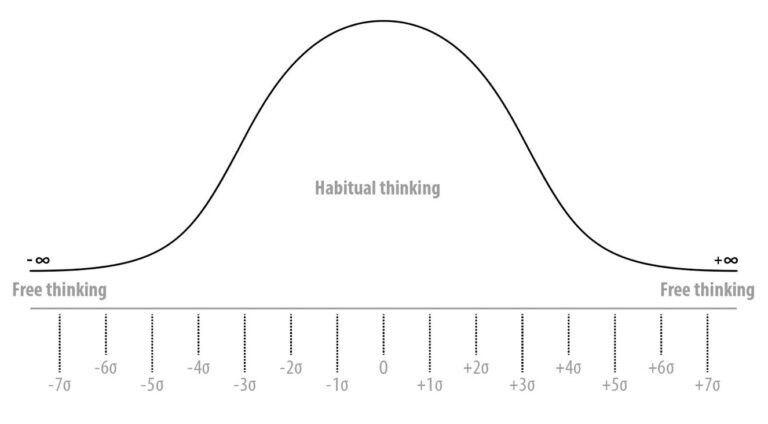
The name borrows a term from statistics. Sigma (σ) describes how far values spread around their average. Applied to thinking: most of our thoughts stay close to what we have thought before, and only a few move further away. Thoughts that differ a great deal from our usual patterns are rare, and they are often where new possibilities appear.
Six Sigma is a well-known business method that improves processes by reducing variation. In the book, the Six Sigma Mindset stands for thinking that keeps variation low. The Seven Sigma Mindset adds room for rarer, freer thoughts, without giving up the reliable ones.